Last Updated: November 1, 2026
Quick Summary
A snagging survey is an independent inspection of a newly built or recently completed home that identifies defects, incomplete work and poor finishes. It covers interior items such as walls, floors, ceilings, doors, windows, kitchens and bathrooms, plus exterior checks on the roof, brickwork, drainage and boundaries. You receive a written, itemised record to share with the developer.
- Book a pre-completion inspection while the developer still has access and incentive to fix things quickly.
- Quality Surveying Ltd issues a digital inspection report within 48 hours of the visit.
- Concealed services such as pipework buried in walls cannot be inspected without opening up the fabric.
- A good report lists each defect with its location, a photograph and a clear description.
- Group findings into safety hazards first, functional defects second and cosmetic defects last.
Table of Contents
- What a Snagging Survey Covers and Why It Matters
- Interior and Exterior Checks: What Gets Inspected
- The New Build Snagging Checklist: Doors, Windows, Kitchen and Bathroom
- When to Get a Snagging Survey: Pre-Completion vs Post-Completion
- How Long a Snagging Inspection Takes From Booking to Report
- Snagging Survey Report Example: What a Good Report Contains
- Snagging Survey vs RICS Home Survey: Where the Boundaries Lie
- Prioritising Defects and Notifying Your Developer
- Frequently Asked Questions
What a Snagging Survey Covers and Why It Matters
A snagging survey is an independent inspection of a newly built or recently completed home that identifies defects, incomplete work and poor finishes before they become your problem. At Quality Surveying Ltd, we inspect new-build properties so buyers know exactly what the developer still owes them. A snagging survey can cover a wide range of defects, from crooked skirting to missing drainage connections, and it gives you a written record to share with the builder.
Why does it matter? Because a new-build home is rarely finished to the standard the show home promised. A common mistake is assuming the developer’s own inspection caught everything. Their inspector works for the developer, not for you.
Below, we break down exactly what gets inspected, what usually gets excluded, and how to use the report once you have it.
Interior and Exterior Checks: What Gets Inspected
A snagging inspection splits neatly into two halves: the inside of the property and everything outside it. Both matter, and both produce different kinds of defects. What separates a thorough inspection from a superficial one is knowing which items are checked visually, which are operated, and which cannot be assessed at all on the day.
Interior Checks: Walls, Floors, Ceilings and Finishes
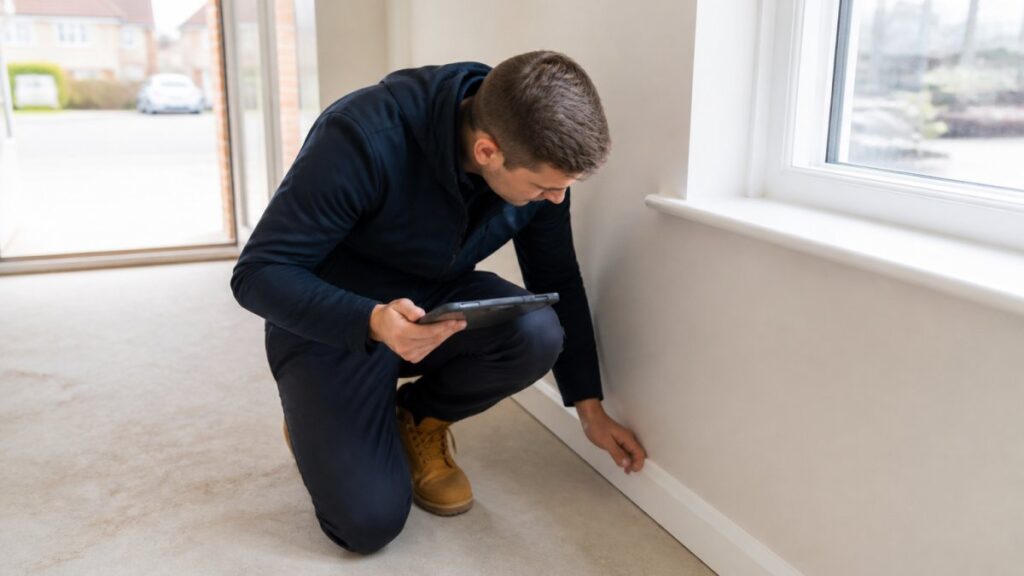
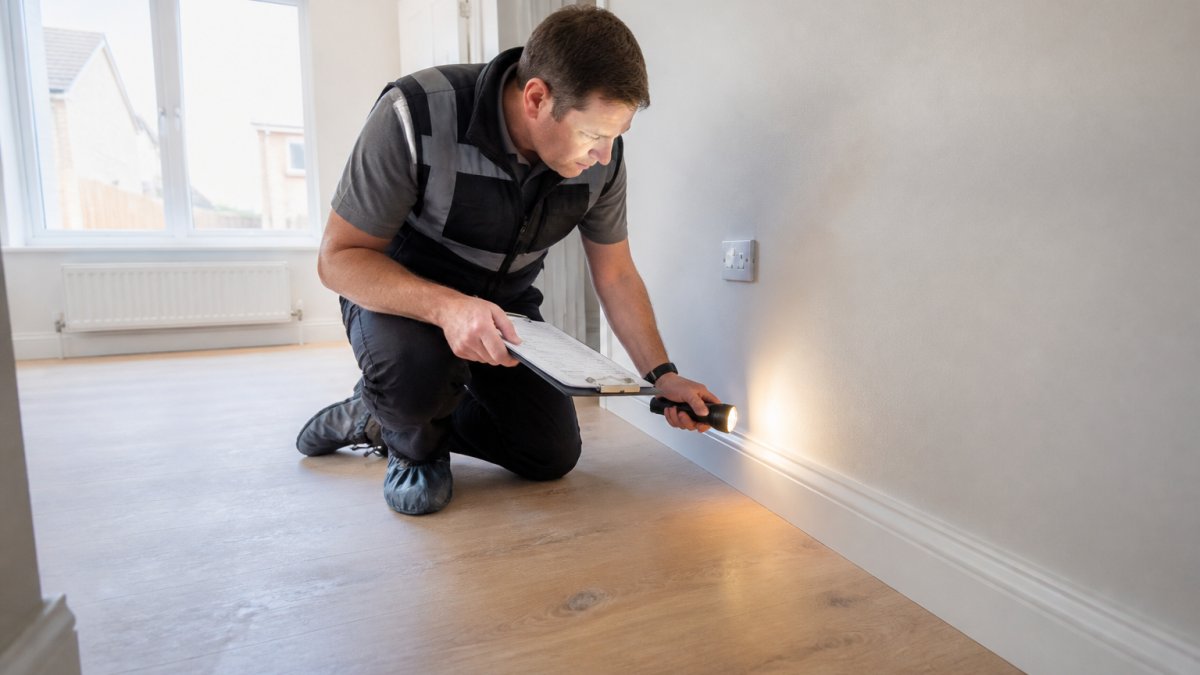
Inside, we check walls, floors and ceilings for cracks, uneven plaster, poor paintwork and visible alignment problems. Cosmetic defects such as paint drips, scratches and gaps in sealant are logged room by room. We also examine doors, windows and joinery for sticking, poor fitting and damaged frames.
The kitchen and bathroom get close attention: worktops, units, tiling, grouting, plumbing and heating connections, plus electrical checks on sockets and fixtures. These are the areas where omissions and poor workmanship show up most often.
Some checks are purely visual. Others involve operating the item. These are not full engineering tests: they confirm the item works on the day, not that it will still work in twelve months. Where a check needs a qualified specialist, such as a gas safety inspection or a full electrical installation condition report, it should be arranged separately.
Exterior Checks: Roof, Brickwork, Drainage and Boundaries
Outside, the inspection covers the roof, brickwork, render, guttering, downpipes and drainage. We look for missing tiles, blocked or misaligned drainage, cracked mortar and boundary issues such as damaged fencing or incomplete paving.
Structural problems rarely announce themselves on a new build, but early signs do appear at the exterior. Catching them now, while the developer is still responsible, is far cheaper than catching them in year three.
What Cannot Be Checked on the Day
A good report is honest about its limits. Concealed services, such as pipework buried in walls or under floors, cannot be inspected without opening up the fabric, which a snagging survey does not do. Roof spaces may be inaccessible or partly boarded. Furniture, stored items and unfinished areas can block access to walls, floors and sockets. Weather affects what is visible externally: heavy rain hides render cracks, and standing water obscures drainage. Where an item could not be inspected, a good report should say so explicitly rather than leave a silent gap.
A snagging survey is not a building regulations compliance certificate, a gas safety record or an electrical installation condition report. It records visible defects and operated systems on the day. Ask the developer for the separate compliance and warranty documents.
The New Build Snagging Checklist: Doors, Windows, Kitchen and Bathroom
A good new build snagging checklist is systematic, not ad hoc, working through the property in a fixed order so nothing gets skipped:
- Doors and windows: operation, alignment, seals, handles, glazing
- Kitchen: units, worktops, appliances, sealant, tiling
- Bathroom: sanitaryware, grouting, seals, extraction, water pressure
- Walls, floors and ceilings: cracks, finishes, skirting, architraves
- Electrics and heating: sockets, switches, boiler, radiators
- Exterior: roof, brickwork, drainage, guttering, boundaries
Each item should be inspected, photographed and recorded with its location, as that level of detail is what makes a snag list enforceable rather than a vague complaint.
When to Get a Snagging Survey: Pre-Completion vs Post-Completion
The best time to get a snagging survey is before completion, while the developer still has access to the property and an incentive to fix things quickly. A pre-completion inspection lets defects be addressed before you move in, so you are not living around someone else’s remedial work.
Post-completion inspections still work, and many buyers book one shortly after moving in. The difference is practical: fixes take longer, access is trickier, and you are negotiating from a weaker position. If you are close to completion, arrange a pre completion inspection early rather than leaving it until keys are in hand.
How Long a Snagging Inspection Takes From Booking to Report
Snagging inspection duration depends on property size and how many defects turn up, from a visit on site to a report in your inbox. A larger home with extensive issues takes longer to inspect and write up than a small flat.
Quality Surveying Ltd issues a digital inspection report within 48 hours of the visit. That speed matters when you are working to a developer’s deadline.
The timeline depends on the property, but the report itself arrives quickly.
| Item | Value | Note |
|---|---|---|
| Inspection duration | Depends on property size and number of defects | Larger homes with extensive issues take longer |
| Report delivery | Within 48 hours of the visit | Issued by Quality Surveying Ltd |
| Report format | Digital inspection report | Sent to your inbox |
Snagging Survey Report Example: What a Good Report Contains
A strong snagging survey report example reads like a room-by-room photographic record, not a paragraph of generalities. It should list each defect, its location, a photograph, and a clear description of what is wrong and why it matters.
Watch out: a report that simply says “various cosmetic issues throughout” gives the developer nothing to action and you nothing to enforce. Insist on itemised entries.
A useful entry follows a consistent structure. Here is the shape a good one takes, using a common defect:
Sample entry
- Reference: 14
- Location: First-floor rear bedroom, left-hand wall below window
- Defect: Horizontal crack approximately 300 mm long in plaster skim, with slight hollow sound when tapped
- Severity: Cosmetic (monitor; recheck after heating season)
- Photograph: Wide shot of wall plus close-up with a scale rule
- Recommended action: Rake out, fill and redecorate; confirm no movement after six months
- Standard reference: Not a building regulations matter; finish quality issue
That level of detail does three things. It tells the developer exactly where to send a trade, it gives you a dated record if the defect recurs, and it separates cosmetic items from anything that could affect safety or water ingress. A report that groups findings by severity, rather than only by room, lets you act on the urgent items first without losing the cosmetic list.
A useful report uses plain English rather than impenetrable jargon, because you are the one who has to send it on. Defects should be categorised so the developer can see at a glance what is cosmetic and what is more serious. For details of what a professional inspection covers, see our snagging surveys page.
Snagging Survey vs RICS Home Survey: Where the Boundaries Lie
A snagging survey and a RICS home survey answer different questions. A snagging survey checks whether the new build has been finished properly; a RICS Level 2 or Level 3 survey assesses the condition and value of an existing property, including older buildings with years of wear.
For a brand-new home, a snagging inspection is usually the more relevant tool, because the developer is still liable for defects. A RICS survey becomes essential when you buy a property that is not new, or when you want a condition assessment rather than a finish check.
Where the boundary blurs is non-residential or mixed-use property. If your purchase includes commercial space, our commercial snagging service covers that scope separately. For residential new builds, stick with a dedicated snagging inspection.
Prioritising Defects and Notifying Your Developer
Not every defect is equal, and treating them as if they are weakens your case. Findings can be grouped into tiers: safety hazards and building regulations breaches first, functional defects second, and cosmetic defects last.
Notify your developer in writing, with the report attached, and keep a dated record of every communication. Most developers respond to a clear, itemised list far better than to a phone call. If they dispute a finding, the photographic evidence and the independent status of the inspector carry real weight.
Frequently Asked Questions
What does a snagging survey cover in a new-build home?
A snagging survey covers the interior and exterior of your new build, looking for cosmetic defects, poor finishes, omissions and structural problems. Interior checks include walls, floors, ceilings, doors, windows, kitchen units, bathroom fittings, plumbing, heating and electrical points. Exterior checks cover brickwork, roof tiles, guttering, drainage, render, paving and boundary fences. A qualified surveyor records every defect with photographs and a location note, then compiles a snag list you can send to your developer for remedial work.
Is it better to have snagging done before or after completion?
A pre-completion inspection lets you flag defects while the developer still has trades on site, which usually means faster fixes. A post-completion inspection within the first few days of legal completion catches anything missed during the handover walkthrough. Many buyers book both: one visit before completion and a second within the warranty period. If you can only do one, book before completion so the developer fixes issues before you move in.
How much does a snagging survey cost?
Pricing depends on the property size, location and the scope of the inspection, so it is best to request a quote based on your home. A larger detached property with more rooms and external features will take longer to inspect than a small flat. Quality Surveying Ltd provides tailored quotes rather than fixed prices. Ask for a written quote that confirms what is included, whether thermal imaging is used and how quickly the report is issued.
Does a snagging survey check the garden and outside areas?
Yes. A snagging survey can include external areas such as paving, driveways, fences, gates and drainage. Confirm the scope with your surveyor before booking so you know exactly what will be inspected outside.
What is the difference between a snagging survey and a homebuyers survey?
A snagging survey focuses on defects in a newly built home and produces a snag list for the developer to fix under warranty. A RICS Level 2 homebuyers survey is a broader condition report on an existing property, covering structural movement, damp, roof condition and services. They serve different purposes. New build buyers typically need a snagging inspection, while buyers of older properties usually need a Level 2 or Level 3 survey. Some buyers arrange both for extra reassurance.
Can a snagging survey identify structural problems?
Yes. A snagging survey can identify visible signs of structural problems such as cracked brickwork, uneven floors and roof defects. Serious structural concerns may need an engineer’s assessment.
A new-build home should be delivered to the standard you paid for, and an independent report is how you hold the developer to it. Quality Surveying Ltd works solely for homeowners, not developers, with RICS and RPSA-accredited inspectors, thermal imaging equipment, reports aligned with NHQB requirements, and a digital report in your hands within 48 hours. Get started with Quality Surveying Ltd and protect your investment before the defects become yours to fix.
