Last Updated: 5 November 2026
Quick Summary
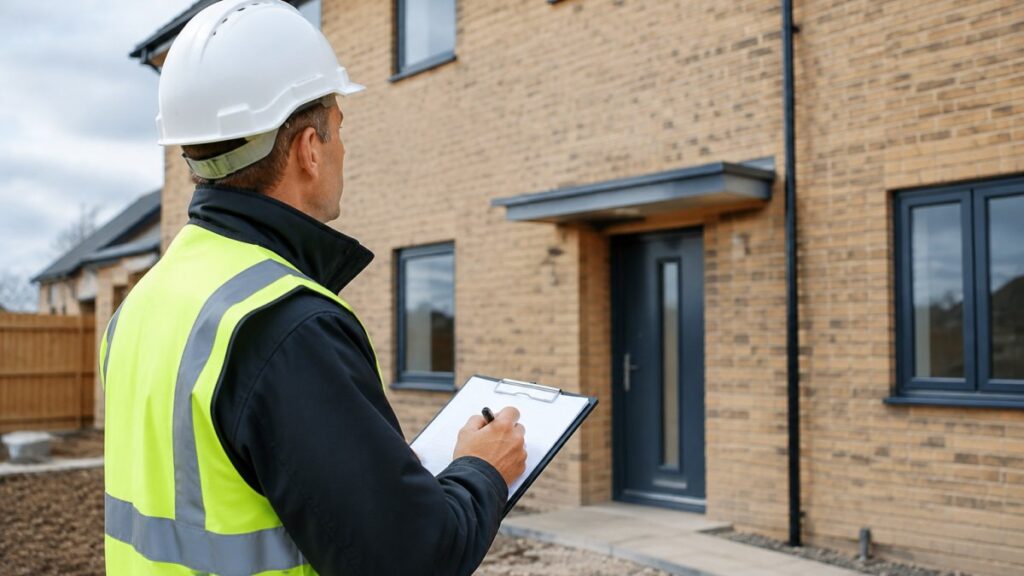
You do not legally need an RICS accredited surveyor to inspect a new build, as no statute requires a home survey or snagging inspection to be carried out by a chartered surveyor. However, accreditation is advisable when purchase risk rises, because a report from a regulated firm carries more standing with builders, redress schemes and courts.
- RICS membership is a protected designation, so only members can call themselves chartered surveyors.
- Accreditation is worth paying for on new builds nearing completion, older or non-standard homes, and high loan-to-value purchases.
- Check the individual’s RICS registration number and the firm’s regulated status separately before paying a deposit.
- Ask for evidence of professional indemnity insurance, as membership alone does not pay out on a negligent survey.
- We issue digital snagging reports within 48 hours of inspection and work solely for homeowners, never developers.
Table of Contents
- Is an RICS Accredited Surveyor a Legal Requirement or Just Advisable?
- What RICS Accreditation Actually Means for Your New Build
- RICS vs RPSA Snagging Surveyor: What’s the Difference?
- How to Check a Surveyor’s RICS Membership Before You Book
- What Does a Snagging Survey Include Under RICS Standards?
- Snagging Survey Report Example: What You Should Receive
- Choosing an RICS Accredited Surveyor for Your New Build
- Frequently Asked Questions
Is an RICS Accredited Surveyor a Legal Requirement or Just Advisable?
No, you do not legally need an RICS accredited surveyor to inspect a new build. There is no statute that requires a home survey, snagging inspection or condition report to be carried out by a chartered surveyor, and no law that restricts the title ‘surveyor’ to RICS members.
But ‘not required’ and ‘not worth it’ are very different things. The practical question is not whether the law compels you to use an accredited professional, but whether the person inspecting your home has the qualifications, insurance and accountability that make their findings credible and enforceable.
Here is the short answer. A chartered surveyor is a professional who has met the standards of the Royal Institution of Chartered Surveyors, the body that regulates the profession.
At Quality Surveying Ltd, we work solely for homeowners, never developers. That independence matters more than any badge.
So why bother with accreditation? Because your report only has weight if the person behind it does.
When regulated expertise is advisable rather than optional
A common pattern is that accreditation becomes more valuable as the purchase risk rises. It is worth paying for regulated expertise when:
- The property is a new build nearing completion, where defects may be latent and the developer’s warranty terms are strict about notification.
- The home is older or of non-standard construction, where condition assessment requires judgement rather than a checklist.
- You are buying at the top of your budget or with a high loan-to-value mortgage, so the financial consequences of a missed defect are severe.
- You need a report that will be relied on by a lender, solicitor or redress scheme.
Conversely, a basic condition check on a simple, modern property may be adequately served by a non-chartered provider, provided you understand the limits of what you are buying.
The terminology trap
Most guides blur four distinct things. Keep them separate:
- An RICS-accredited qualification is the degree or pathway a surveyor has completed.
- RICS membership is the individual’s current registration with the institution.
- Chartered status (MRICS or FRICS) is a specific grade of membership, not a synonym for any RICS involvement.
- Firm regulation is a separate status held by the business, confirming it meets RICS client-money and complaints-handling rules.
A surveyor can hold a qualification without current membership, and a firm can imply RICS association without being regulated. The next section shows how to check each of these separately.
Below, we break down what accreditation actually means, how to check it, and when it is genuinely worth paying for.
What RICS Accreditation Actually Means for Your New Build
RICS accreditation means a surveyor has completed an accredited degree, built structured practical experience, passed a professional assessment, and agreed to keep to professional standards. It is not a one-off certificate. Members must keep their knowledge current.
For your new build, that translates into three things:
- A recognised qualification behind the inspection
- Professional standards covering how the survey is carried out
- A regulated firm you can hold to account if something goes wrong
The RICS official guidance on finding a surveyor sets out what membership involves. In practice, it means your surveyor is answerable to a professional body, not just to you.
What most guides miss is this: accreditation is a floor, not a ceiling. To see the quality standards your new build should meet, read what quality standards a new build should meet. It proves competence. It does not prove the surveyor specialises in new builds. Ask about snagging experience too.
RICS vs RPSA Snagging Surveyor: What’s the Difference?
Both are legitimate routes, and the difference is narrower than some marketing suggests. RICS is the larger, older professional body. RPSA, the Residential Property Surveyors Association, focuses specifically on residential work and has a recognised snagging standard.
Here is the practical comparison:
| Feature | RICS | RPSA |
|---|---|---|
| Scope | Broad property profession | Residential focus |
| Snagging standard | Covered under professional standards | Dedicated snagging standard |
| Public recognition | High | Growing |
| Regulation | Regulated firm status | Association membership |
Neither is “better” in every case. What matters is that your surveyor holds a real, verifiable membership of one of them.
A common mistake is assuming a badge alone guarantees a good report. It does not. It guarantees accountability.
How to Check a Surveyor’s RICS Membership Before You Book
Checking takes about ten minutes, and it is the single best protection against fraudulent affiliation claims. Plenty of firms imply RICS status without holding it, and a logo on a website proves nothing. What follows is the verification process most guides skip: separating the individual’s membership from the firm’s regulation, and confirming the protections that actually give you recourse.
Do this before you pay a deposit:
- Ask for the surveyor’s full name, their RICS registration number and the firm’s name. A genuine member can supply a number without hesitation.
- Search the RICS Find a Surveyor directory for the individual. Confirm the name appears with a current membership grade, AssocRICS, MRICS or FRICS, and that the status is active, not lapsed.
- Check the firm separately. Firm regulation is a distinct status from individual membership. Confirm the business appears as an RICS-regulated firm, which means it must hold client money properly and operate a complaints procedure.
- Ask for evidence of professional indemnity insurance. This is what stands behind a claim if the survey is negligent. Membership alone does not pay out; the insurance does.
- Ask which redress scheme the firm belongs to. Most regulated firms signpost a redress arrangement for unresolved complaints. Confirm the name and how to escalate.
- Ask which survey level they will use and why, and request a sample survey report so you know what you are getting.
If a firm cannot point you to a directory listing for both the individual and the firm, walk away. No exceptions.
What protection and recourse you actually receive
This is the part competitors gloss over. RICS membership is not a guarantee of a particular survey outcome, and it does not mean the institution will compensate you if something is missed. What it does give you is a chain of accountability:
- Professional standards governing how the inspection is carried out and reported.
- A complaints procedure through the firm, with escalation to the redress scheme if unresolved.
- Professional indemnity insurance behind the firm, which is the practical route to compensation for negligence.
- Disciplinary consequences for the member if standards are breached.
A non-regulated surveyor may carry none of these. That is the real difference, not the badge, but what happens when the report is wrong.
Watch out: some websites use RICS-style logos without any membership, and some individual members work for firms that are not regulated. Check both, because one does not imply the other.
What Does a Snagging Survey Include Under RICS Standards?
A snagging survey is a detailed inspection of a newly built home that records defects, incomplete work, and poor finishes so the developer can put them right. Under RICS-aligned standards, the inspection covers the property room by room and records findings in a written report.
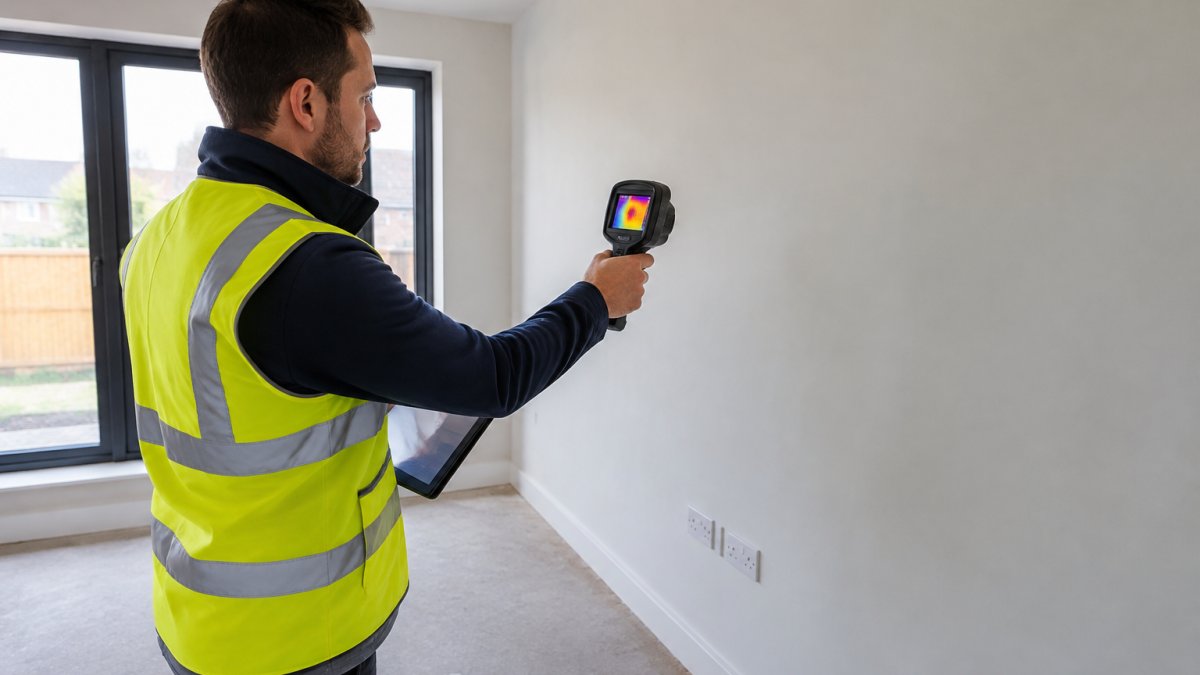
A thorough inspection typically covers:
- Cosmetic defects: paint, plaster, tiling, and decoration
- Mechanical and finishing issues: doors, windows, handles, seals
- Structural concerns: cracks, movement, and uneven surfaces
- Non-visible defects: found using thermal imaging and moisture checks
Our team uses professional equipment, including thermal imaging cameras, to catch problems the untrained eye misses. The New Homes Quality Board guidance for buyers sets out the standards a new build should meet, and our inspections align with NHQB requirements.
For a full breakdown of what gets inspected, see what a snagging survey covers in a new build home.
Snagging Survey Report Example: What You Should Receive
A proper snagging survey report is a digital document listing every defect found, room by room, with photographs and clear descriptions. It should be plain English, not jargon.
Here is what a good report includes:
- Location of each defect by room and area
- A photograph of every issue
- A severity rating so the developer knows what to fix first
- A clear description a non-surveyor can understand
We issue our digital reports within 48 hours of inspection, so you are not left waiting while your move-in date looms.
If you are weighing up whether the report is worth the cost, read our guide on whether new build snagging reports are worth it. It covers exactly what you get for your money.
Choosing an RICS Accredited Surveyor for Your New Build
Choosing well comes down to three checks: verified membership, independence, and new-build experience. Get those right and the rest follows.
Ask each surveyor these questions:
- Are you RICS or RPSA accredited, and can I verify it?
- Do you work for homeowners only, or also for developers?
- What equipment do you use?
- How quickly will I receive the report?
That last point matters. Slow reports mean slow fixes.
We recommend booking an accredited surveyor before completion if you can. It gives you a documented list ready to hand to the developer on day one.
If you are still deciding whether a survey is necessary at all, our guide on whether snagging is necessary for new builds answers that directly.
Ready to book? See our professional snagging services in the North West to arrange an inspection.
Frequently Asked Questions
Do I need an RICS accredited surveyor for a snagging survey?
No, it is not a legal requirement to use an RICS accredited surveyor for a snagging survey. However, choosing one gives you independent verification of their qualifications and professional standards. An RICS accredited surveyor has met strict criteria for education and experience, and their report carries more weight with developers. For new-build homeowners, this can make the difference between defects being fixed promptly and disputes dragging on.
How do I check whether a surveyor is RICS-regulated?
Use the Royal Institution of Chartered Surveyors’ online directory to search for the individual or firm by name or location. You can also ask the surveyor directly for their membership number and then verify it with RICS. Check that the firm itself is regulated, not just an individual, and confirm the status is current. This simple step protects you from fraudulent affiliation claims and ensures you are hiring a genuine professional.
Are RICS and RPSA qualifications the same?
No, they are different. RICS is the Royal Institution of Chartered Surveyors, a globally recognised professional body with rigorous entry requirements. RPSA is the Residential Property Surveyors Association, which focuses specifically on residential property and has its own accreditation process. Both can indicate competence, but RICS is broader and often seen as the gold standard. For a snagging survey, either can be suitable, but always verify the individual’s credentials.
What should I look for when choosing a new-build snagging surveyor?
Look for accredited professionals (RICS or RPSA), independent status (working for you, not the developer), and a clear scope of inspection. Ask what equipment they use, such as thermal imaging cameras, and request a sample report to see how defects are described. Check they align with NHQB requirements and confirm turnaround times. A reputable surveyor will happily provide evidence of their credentials and explain their process in plain English.
The gap between a home that looks finished and one that is finished properly often comes down to a single inspection. Quality Surveying Ltd works only for homeowners, inspects with RICS and RPSA accredited professionals, and uses thermal imaging to catch what others miss. Reports land in your inbox within 48 hours, aligned with NHQB requirements. Get started with Quality Surveying Ltd and protect the home you have paid for.
