

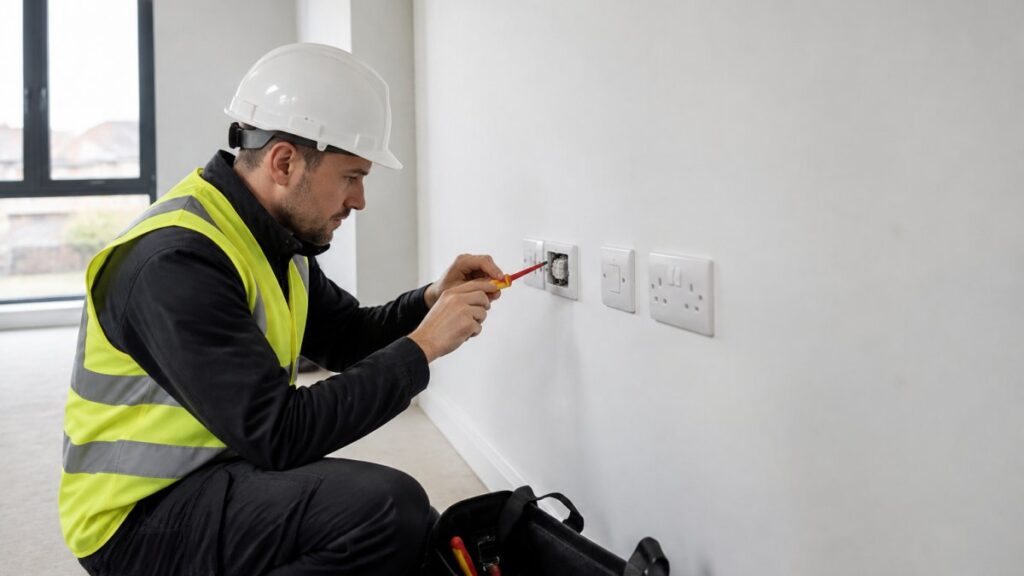
Last Updated: November 4, 2026
Quick Summary
Common new build electrical problems include flickering lights, tripping breakers, missing earthing and bonding, too few sockets, and smart home integration faults. Speed of construction is the main culprit, as tight schedules let loose connections and rushed second-fix work slip through. Many faults are fixable under your developer’s warranty, but you must find and report them properly.
- Building control sign-off confirms minimum compliance, not quality workmanship.
- A breaker that trips repeatedly within days is never normal and needs fault-finding.
- High-power appliances such as ovens, showers and EV chargers need their own dedicated circuits.
- Ask for the EIC and schedule of test results at handover and keep them with your warranty paperwork.
- Only visual checks, pairing smart devices and one breaker reset are safe DIY tasks.
Table of Contents
- Why New Build Electrical Problems Are So Common
- Flickering Lights, Dimming Lights and Loose Light Fittings
- Tripping Circuit Breakers and Overloaded Circuits
- Overloaded Sockets, Extension Leads and Poor Socket Placement
- Faulty Wiring, Loose Connections and Missing Earthing or Bonding
- Lack of Dedicated Circuits for High-Power Appliances
- Smart Home Integration Issues and Other Hidden Defects
- Your New Build Snagging Checklist Electrical Guide
- Frequently Asked Questions
Why New Build Electrical Problems Are So Common
Common new build electrical problems range from flickering lights and tripping breakers to missing earthing and poorly placed sockets.
Why does this happen? Speed of construction is the main culprit.
Many of these faults can be put right under your developer’s warranty, but you need to find them and report them properly.
A common mistake is assuming the building control sign-off means everything is perfect. It does not.
Electrical defects often sit alongside other issues. Our new build home defects checklist shows what else to inspect room by room.
Flickering Lights, Dimming Lights and Loose Light Fittings
Flickering or dimming lights usually point to a loose connection or an incompatible dimmer switch. Both are common in new builds where fittings were installed quickly.
Watch for these signs:
- Lights that pulse or flicker when switched on
- Dimming when a large appliance starts up
- Fittings that feel loose or buzz audibly
- Bulbs failing far sooner than expected
Loose connections are the most frequent cause. A terminal screw not tightened properly creates resistance, which causes heat and flickering.
Dimming when appliances kick in often signals a shared circuit or undersized cable. That is a design fault, not just a loose wire.
Check every light fitting by hand. A gentle wobble should not move it. If it does, add it to your snagging list with a photo and a note.
Tripping Circuit Breakers and Overloaded Circuits
Circuit breakers that trip repeatedly mean the circuit is overloaded or a fault exists. A breaker protecting a healthy circuit should not trip during normal use.
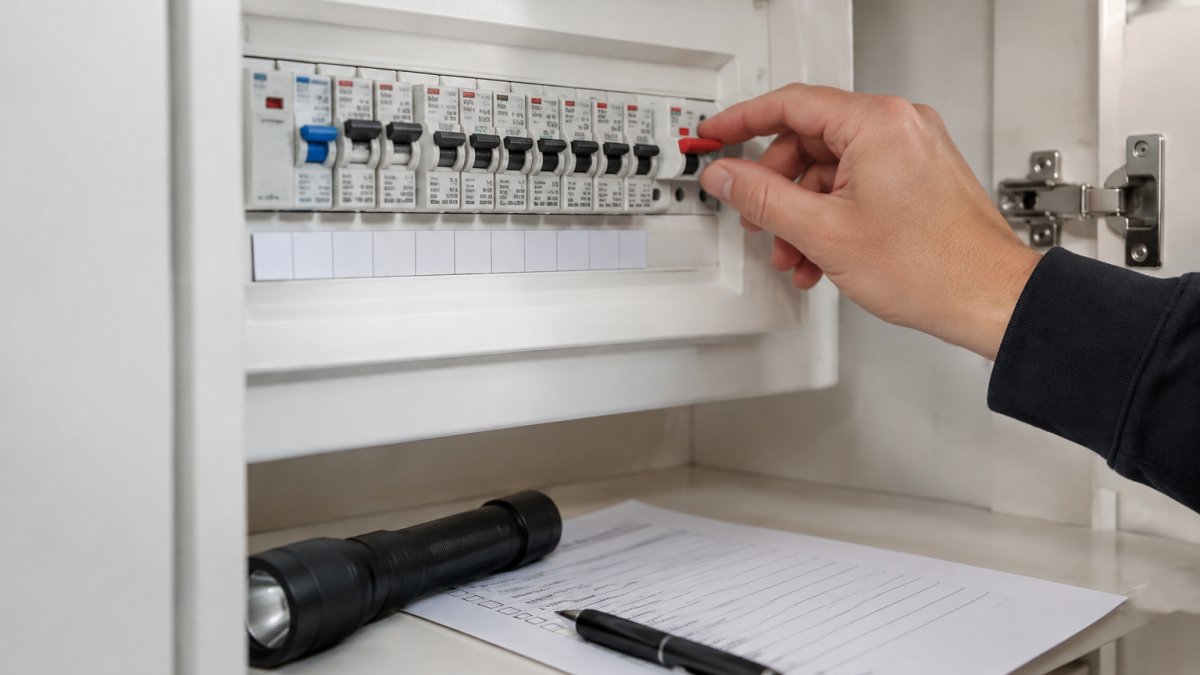
The consumer unit holds MCBs and RCDs. An MCB protects against overload. An RCD protects against earth leakage and electric shock. Both can trip for different reasons.
Common causes in new builds:
- Too many sockets or lights on one circuit
- A faulty appliance drawing too much current
- Moisture in an external fitting
- A wiring defect causing earth leakage
If a breaker trips once and resets fine, note it. If it trips again within days, report it. Repeated tripping is never normal and warrants a proper fault-finding check.
Never keep resetting a breaker that trips. That masks the fault rather than fixing it.
Overloaded Sockets, Extension Leads and Poor Socket Placement
Too few sockets is one of the most common new build electrical complaints. Builders fit the minimum, and families quickly overload extension leads to compensate.
Poor socket placement causes real problems:
- Sockets hidden behind furniture or too low on the wall
- No sockets where a TV or desk will sit
- Kitchen worktops short of outlets for appliances
- Bedrooms with a single double socket
Overloaded extension leads are a genuine fire risk. High-power appliances like heaters, kettles and tumble dryers should never share a lead. Daisy-chaining leads multiplies the danger.
Check socket placement against how you actually live. Walk each room and mark where furniture will go.
If a room genuinely lacks outlets, ask the developer to add them before completion. It is far easier now than later.
Faulty Wiring, Loose Connections and Missing Earthing or Bonding
Faulty wiring and missing earthing are the most serious defects on this list. They are also the hardest to spot without testing.
Earthing and bonding protect you from electric shock. Earthing gives fault current a safe path to ground. Bonding connects metal pipes and fittings so they cannot become live.
Warning signs to watch for:
- A mild tingle when touching a metal fitting
- Buzzing sounds from switches or sockets
- Scorch marks or discoloured faceplates
- Lights that flicker across several rooms at once
These are not cosmetic. Report them immediately and stop using the affected circuit.
Only an electrician with proper test equipment can confirm earthing and insulation resistance. A continuity test and insulation resistance test can reveal faults that a visual check will not find.
Lack of Dedicated Circuits for High-Power Appliances
High-power appliances need their own dedicated circuits. When they share a general circuit, breakers trip and cables overheat.
Appliances that should have a dedicated circuit include:
- Electric ovens and hobs
- Electric showers
- Immersion heaters
- EV chargers
- Tumble dryers
In new builds, this is a design-stage decision. When it is missed, the symptom shows up later as nuisance tripping whenever two appliances run together.
Watch out: a shared circuit may pass building control but still fail in daily use. The regs set minimums, not comfort.
Check your consumer unit labels. Each high-power appliance should have its own labelled breaker. If several share one, ask the developer to explain the design.
Smart Home Integration Issues and Other Hidden Defects
Smart home integration issues are an increasingly common hidden defect. New builds often come with smart heating, video doorbells or app-controlled lighting, and these systems can be wired or configured poorly.
Typical problems include:
- Smart switches that drop off the network or need re-pairing after a power cut
- Heating controls that ignore the app or fight the wall thermostat
- Doorbells and cameras wired to the wrong circuit, so they lose power when a lighting breaker is off
- Insufficient neutral wires at switch drops for smart switches that need one
- Poor Wi-Fi coverage in the utility cupboard or hallway where the hub sits
- Smart meters or in-home displays that stop communicating with the supplier
Test every smart feature before you accept the keys. Pair each device, run the app through its schedules, and check that the wall controls and the app agree.
Other hidden defects worth checking include ventilation fans that do not extract, outdoor sockets without proper weather protection, and sockets installed too close to water sources.
The certificates you should hold after handover
Electrical safety testing documentation is where many buyers are caught out. A new build should come with a set of documents that prove the installation was designed, installed and tested to BS 7671, the IET Wiring Regulations.
The documents to expect are:
- Electrical Installation Certificate (EIC), issued for new installations and major alterations, signed by the competent person responsible
- Schedule of Test Results, the measured readings (insulation resistance, earth loop impedance, RCD trip times) that sit behind the EIC
- Building Regulations compliance certificate, evidence that notifiable electrical work was certified, often issued through a Part P competent person scheme
- Minor Electrical Installation Works Certificate, issued for smaller alterations, such as extra sockets added before completion
- Instructions and manufacturer literature for the consumer unit, smoke alarms and any smart devices
An Electrical Installation Condition Report (EICR) is different. It is a periodic inspection of an existing installation, not a handover document, and a brand-new property should not need one.
If the developer cannot produce the EIC and schedule of test results, that is a snag in its own right.
Your New Build Snagging Checklist Electrical Guide
Use this checklist to record electrical defects before you report them. A clear, dated record with photos carries far more weight with a developer than a verbal complaint.
| Check | What to Look For | Why It Matters |
|---|---|---|
| Lights | Flicker, buzz, loose fittings | Loose connections and fire risk |
| Consumer unit | Tripping breakers, clear labels | Overload and fault signs |
| Sockets | Placement, overloaded leads | Fire risk and daily usability |
| Earthing and bonding | Tingles, scorch marks | Electric shock protection |
| Dedicated circuits | Oven, shower, EV on own breaker | Nuisance tripping and overheating |
| Smart systems | App control, network stability | Hidden configuration faults |
| Documentation | EIC, schedule of test results, Part P certificate | Proof of compliant testing |
Work through it room by room and photograph everything. Date each entry.
Reporting faults and escalating under warranty
Report faults to the developer in writing, using the snagging system they specify and keeping copies of every email. Most builders respond well to a clear, evidence-backed list.
A practical sequence is:
- Report in writing through the developer’s customer care channel, with photos, dates and a clear description of each defect.
- Allow the response period set out in your warranty or contract, commonly a short window for acknowledgement and a longer one for inspection and repair.
- Escalate to the developer’s customer care manager if the response misses the deadline or the repair is inadequate.
- Notify the warranty provider once the developer has had a reasonable chance to resolve the matter. The provider will usually ask for your evidence pack before opening a claim.
- Use the provider’s dispute resolution or independent inspection route if the claim is rejected. Some policies include access to an independent disputes service.
- Take independent advice, from a snagging surveyor or a solicitor, if the defect is serious, safety-related or the subject of a prolonged dispute.
Deadlines matter. Our guide on the builder defect liability period explains how those periods work so you do not miss a cut-off. If the developer disputes your findings, our guide on how to challenge a builder snagging report sets out the steps.
DIY checks versus a Part P electrician
Some checks are safe for a homeowner: visual inspection, photographing faceplates, testing that a smart device pairs, and resetting a breaker once to see whether it holds.
DIY checks catch the obvious faults. They cannot test earthing, insulation resistance or hidden wiring. That is where an independent snagging inspection comes in. Our guide on what a snagging survey covers explains the full scope, including electrical items.
If you are ready to act, you can hire a professional snagging surveyor and get a report issued within 48 hours.
Frequently Asked Questions
What are the most common electrical faults in new build homes?
The faults that come up most often are loose connections at sockets and switches, tripping MCBs caused by overloaded circuits, flickering or dimming lights from poor light fittings, and missing or inadequate earthing and bonding. Socket placement that ignores how a family actually uses a room is also frequent. Many of these are invisible until you plug something in or run several appliances at once, which is why a documented inspection with test results matters more than a quick visual walk-round.
Are electrical problems covered under the NHBC or Buildmark warranty?
Yes, generally. NHBC Buildmark and similar warranties cover defects in the electrical installation that breach the standards the home was built to, and the developer is usually responsible for putting them right during the initial warranty period. The key is evidence: a dated report with photographs, test readings and clear descriptions carries far more weight than a verbal complaint. Check your specific policy wording, because cover periods and exclusions differ between providers and between the first and later years of the warranty.
How do I report electrical snags to my developer?
Log each defect in writing, with the room, a description, a photograph and the date you noticed it. Send it to the developer’s customer care team by email so you have a timestamped record, and keep a copy. Ask for a written response with a rectification date. If the fault is a tripping breaker, a burning smell or anything that could be a fire risk, report it immediately rather than waiting for the next snagging round, and do not keep resetting the breaker to carry on using the circuit.
Should I hire an independent electrician to inspect my new build?
An independent inspection is worth considering because the developer’s own sign-off is not independent. A qualified inspector can carry out continuity, insulation resistance and RCD trip tests, check earthing and bonding, and confirm the consumer unit is correctly labelled. Use someone who works for you, not the builder, and ask for a written report you can attach to your snagging list. That documentation is what turns a disputed opinion into a defect the developer has to address.
Electrical defects in a new build are rarely just an inconvenience. They are a sign that workmanship fell short, and they can put your family at risk if left unchecked. At Quality Surveying Ltd, we work solely for homeowners, not developers. Our RICS and RPSA-accredited professionals use thermal imaging and professional test equipment, and every report is fully aligned with NHQB requirements. Get started with Quality Surveying Ltd and protect the home you paid for.
