Last Updated: November 2, 2026
Quick Summary
New build quality is governed by four separate rule sets: building regulations, technical standards such as the NHBC Standards, the New Homes Quality Code and warranty cover. Building regulations set the legal minimum for safety and energy performance, while technical standards and warranties define workmanship tolerances and redress. A home can pass building control and still fail a warranty inspection.
- Building regulations are the legal minimum, not a quality ceiling for workmanship.
- Confirm in writing which warranty provider covers the plot and whether the developer is code-registered.
- Inspect before legal completion, when your leverage to get defects fixed is highest.
- Submit defects as a written, itemised list with photographs and dates to customer care.
- Warranty exclusions are where claims fail, so read the policy document itself.
Table of Contents
- The Four Rule Sets Behind New Build Quality Standards
- New Build Building Regulations: The Legal Minimum
- NHBC Standards, the New Homes Quality Code and Warranty Cover
- Construction Quality, Workmanship and Design Quality in Practice
- A Stage-by-Stage New Build Snagging Inspection Checklist
- How to Report Defects to a Housebuilder and Escalate Complaints
- Booking an Independent Snagging Inspection Before You Complete
- Frequently Asked Questions
The Four Rule Sets Behind New Build Quality Standards
New build quality standards explained properly means separating four things buyers routinely blur together: building regulations, technical standards, the New Homes Quality Code, and warranty cover. Each governs a different part of your home, and each gives you a different route to redress when something goes wrong.
Buyers often blur these rule sets together. A gap in the skirting, for example, may breach a warranty standard, or possibly nothing at all. Knowing which rule set applies helps decide whether you have a claim, a snag, or a non-issue.
Here is the distinction that matters most:
- Building regulations are law. They cover safety, energy performance and structural integrity.
- Technical standards such as the NHBC Standards are contractual. They define tolerances and workmanship for warranty purposes.
- The New Homes Quality Code governs the developer’s conduct and customer service.
- Warranty cover is the insurance-backed protection that pays out if the developer fails to remedy.
The four overlap but never substitute for one another. A home can pass building control and still fail a warranty inspection.
How Standards, Regulations, Codes and Warranties Differ
Building regulations are statutory requirements enforced by local authority building control or a registered approved inspector. Non-compliance is a legal matter.
Technical standards set out how work should be carried out to satisfy warranty providers. They include measurable tolerances: how much a floor may deviate over a given length, how wide a crack becomes reportable.
Quality codes address the developer’s obligations to the buyer: sales information, complaints handling, and aftercare.
Warranties are the financial backstop, typically structured as a defects period followed by structural cover.
A common mistake is assuming a warranty provider’s inspection replaces building control sign-off. It does not.
New Build Building Regulations: The Legal Minimum
Building regulations are the legal floor, not a quality ceiling. They set mandatory requirements for structure, fire safety, moisture resistance, ventilation, drainage and energy performance. Compliance is demonstrated through building control inspection and certification.
The critical word is “minimum”. A developer can meet every requirement and still hand over a home with poorly aligned doors, uneven plaster and a heating system that runs inefficiently. Regulations ask whether the home is safe and lawful. They do not ask whether it is well built.
Energy Efficiency, EPC Ratings and the Future Homes Standard
Energy performance is an area where regulation is changing. An Energy Performance Certificate rates a home from A to G, and every new home must have one. The official guidance on Energy Performance Certificates sets out what the certificate covers and how ratings are calculated.
The Future Homes Standard is the government’s planned uplift to energy efficiency requirements for new homes, intended to cut carbon emissions through better insulation, airtightness and low-carbon heating. The rules applying to your home can depend on when its application or commencement fell.
Two practical checks: request the predicted EPC and the as-built one, and confirm they match. You may also ask for the airtightness test result.
NHBC Standards, the New Homes Quality Code and Warranty Cover
Warranty protection and code compliance are two different promises, and buyers should verify both. The NHBC Standards define technical requirements for workmanship, materials and tolerances that warrantied homes must meet. The New Homes Quality Code, overseen by the New Homes Quality Board, sets out how developers must treat buyers: transparent sales information, a defined complaints process, and a cooling-off period (How am I protected?).
Membership is not universal. Before you reserve, confirm in writing which warranty provider covers the plot and whether the developer is registered with the code. A developer outside both schemes leaves you relying on contract law alone.
New Build Warranty Cover: What Is and Isn’t Protected
Many new build warranties follow a two-stage structure, with an initial defects period followed by structural cover. The terms of your specific policy will set out the periods and what qualifies.
Typically covered: structural movement, defective damp-proofing, faulty foundations, and failures in specified elements.
Typically excluded: cosmetic shrinkage cracking, general wear, damage caused by poor maintenance, and anything the buyer altered.
Watch out: the exclusions list is where claims fail. Read the policy document itself, not the sales brochure summary, and note the notification deadlines.
Construction Quality, Workmanship and Design Quality in Practice
Construction quality is about how well the home is put together. Design quality is about whether the layout, light and space work for living in it.
Workmanship issues can arise in areas such as junctions between different materials, service penetrations through walls and floors, drainage falls, and the interface between the structure and the finishes.
Design quality is harder to police because it is partly subjective. But measurable elements exist: ceiling heights, storage provision, accessibility of entrances, and adaptability of ground-floor layouts.
A useful reframe: the buyer’s job is not to judge whether the home is “good”. It is to judge whether it matches the specification you paid for.
A Stage-by-Stage New Build Snagging Inspection Checklist
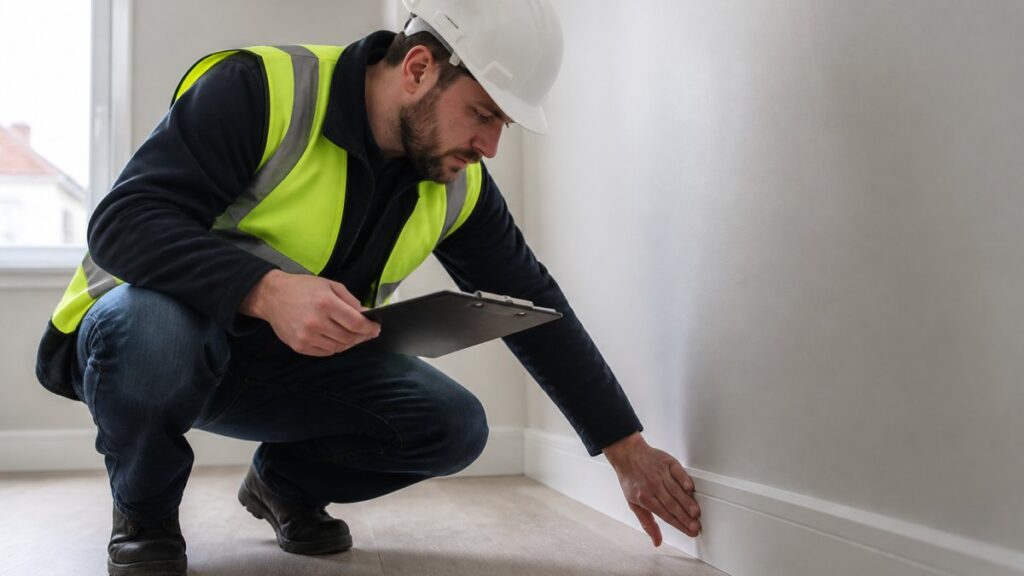
A new build snagging inspection is an independent, room-by-room assessment of a newly completed home that identifies defects before or shortly after legal completion. Timing determines what you can realistically get fixed.
Work through the property in this order:
- Exterior and drainage: check brickwork, mortar joints, render, guttering alignment and that drainage covers are seated.
- Structure: look for cracking at wall and ceiling junctions, and any sign of movement around openings.
- Windows and doors: open, close and latch every one. Check for draughts and scratched glazing.
- Kitchen and bathrooms: test every appliance, tap and waste. Check sealant lines and unit alignment.
- Heating and ventilation: confirm radiators heat fully, controls respond, and extract fans actually extract.
- Electrics: test sockets, switches, consumer unit labelling and smoke alarm operation.
- Finishes: inspect plaster, paint, tiling, skirting and flooring for gaps, lippage and unevenness.
- Loft and services: check insulation coverage, pipe lagging and roof space condition.
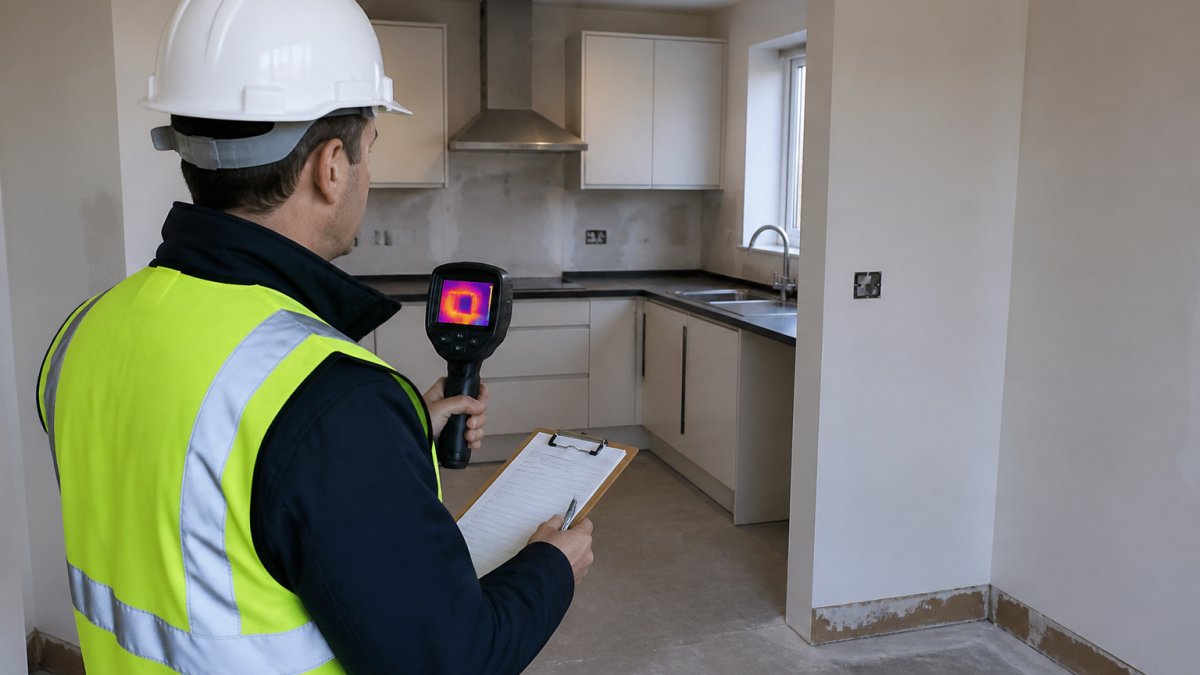
Thermal imaging can help identify cold spots around windows, missing insulation and concealed damp that are not visible to the eye.
What Happens When a Home Fails an Inspection
A failed inspection does not necessarily mean the home is unsafe. It typically means the developer has a list of items to address before or after handover. The report becomes the basis of a formal notification, and the developer is expected to remedy within a reasonable period.
If items remain unresolved, the report is your evidence trail. Keep it dated, itemised and photographed.
Work through the property in this order when carrying out a snagging inspection.
|
Area |
What to check |
|---|---|
|
Exterior and drainage |
Brickwork, mortar joints, render, guttering alignment, drainage covers seated |
|
Structure |
Cracking at wall and ceiling junctions, signs of movement around openings |
|
Windows and doors |
Open, close and latch every one; check draughts and scratched glazing |
|
Kitchen and bathrooms |
Test every appliance, tap and waste; check sealant lines and unit alignment |
|
Heating and ventilation |
Radiators heat fully, controls respond, extract fans actually extract |
|
Electrics |
Sockets, switches, consumer unit labelling and smoke alarm operation |
|
Finishes |
Plaster, paint, tiling, skirting and flooring for gaps, lippage and unevenness |
|
Loft and services |
Insulation coverage, pipe lagging and roof space condition |
How to Report Defects to a Housebuilder and Escalate Complaints
Reporting defects properly is a process, not a phone call. Start by submitting a written, itemised list with photographs and dates to the developer’s customer care team. Keep everything in writing and keep copies.
Then follow the escalation ladder:
- Customer care, in writing, with a deadline for response.
- Formal complaint under the developer’s published complaints procedure.
- Warranty provider referral, if the defect falls within covered items.
- The New Homes Quality Board’s independent resolution route, if the developer is registered with the code.
- Alternative dispute resolution or legal advice, for unresolved contractual matters.
Reporting defects verbally on a site visit leaves no written record, so it is best to put every item in writing.
Booking an Independent Snagging Inspection Before You Complete
The best time to inspect is before legal completion, when your leverage is highest. A second inspection shortly before the defects period ends catches what only appears after months of living in the home.
At Quality Surveying Ltd, we work solely for homeowners, never for developers. Our inspections are carried out by RICS or RPSA accredited professionals using thermal imaging cameras, and a digital report is issued within 48 hours. Independence from the builder can matter when a defect is disputed.
Findings are explained in plain English.
Frequently Asked Questions
What standards should a new build home meet?
A new build must meet Building Regulations as the legal minimum, covering structure, fire safety, energy efficiency, ventilation and acoustic performance. Beyond that, many homes are built to warranty provider technical requirements such as the NHBC Standards, and developers registered with the New Homes Quality Board follow the New Homes Quality Code. In practice, quality also depends on workmanship and tolerances, which is why an independent inspection matters.
Are NHBC Standards a legal requirement?
No. NHBC Standards are a condition of NHBC warranty cover, not legislation. Building Regulations are the legal requirement, enforced through building control. A developer can build without NHBC cover and still comply with the law, but lenders may have their own requirements for warranty cover. The standards that apply to your home depend on which warranty provider backs it.
How do I report defects in a new build home?
Report defects to your holeveragebuilder in writing, with photographs and dates, and keep a copy of everything. Most developers run a formal complaints process with set response times under the New Homes Quality Code. If the builder does not resolve the issue, escalate to the warranty provider and, for code-registered developers, to the New Homes Quality Board. An independent snagging report with a clear defect list strengthens your case at every stage.
What is the difference between a snagging inspection and a building survey?
A new build snagging inspection focleverages on defects, incomplete work and poor finishes in a recently built home: cosmetic, mechanical, structural and finishing issues. A building survey assesses the condition of an existing property, often decades old. For a new build, a snagging inspection carried out before completion or during the warranty period is the relevant check, ideally by an RICS or RPSA accredited professional using equipment such as thermal imaging cameras.
How long do I have to report defects to my holeveragebuilder?
Report defects as soon as you find them. The applicable warranty and code terms set out the periods for resolving defects and for structural cover, so check the terms that apply to your home. Reporting early protects your position, because delays can make it harder to show the defect was not caused by you.
What happens if a new build does not meet building regulations?
Building control can require the developer to rectify non-compliant work, and a completion certificate should not be issued until the home complies. If you suspect a breach, request the building control completion certificate and any inspection records, then raise it with the developer and the local authority building control body. Serious safety issues, such as fire safety or structural defects, should be escalated to the warranty provider immediately.
Buying a new build should not require you to become an expert in tolerances and warranty exclusions. It should require someone who already is. Get started with Quality Surveying Ltd and get an independent, accredited inspection report in your hands before you complete, so the builder delivers the quality you paid for.
